• Breathe deeply - Have you ever noticed your breathing when you're feeling stressed or moving at warp speed? It' s probably shallow and tight. Borrow a tip from professional athletes, and take a few slow, deep breaths to relax and collect yourself.
• Take a walk - "Take a hike" can be good advice. Not only does it help burn off nervous energy, but you can get some exercise and enjoy the scenery, which can help you think more clearly than you might if you' re always tethered to your desk or buzzing about mindlessly.
• Eat well - Busy people can be chronic meal-skippers, or too frequently eat junk food on the run. Heavy foods, too many or too few calories, and inadequate nutrition can make you feel like you're short on fuel. Go for the veggies, fruits, grains and lean proteins - a nutritionist can provide advice and a list of nutritious, high-energy foods.
• Drink water - Most people don't drink enough water, and end up feeling dehydrated, tired, cranky and achy. Next time you feel dry or in need of a liquid "pick me up," go for the water bottle instead of coffee or soda. In fact, experts say that once you feel thirsty, you' re already dehydrated, so drink up. An added bonus? Water helps flush toxins away.
• Slow down - "Type A" stands for anxious, not admirable. Don't worry; you don't have to plod along or come to a stand-still. By making sure your mind is actually where your body is, you' ll feel (and appear) less scattered, think more clearly, and be more effective. Good time-management and delegation strategies can help avoid confused priorities and schedule-melt-downs.
• Team up - If you're a burned-out business owner, chances are good that there' s at least one thing you' re not very good at: letting other people help you get things done. Whether via delegating to employees, partnering with other firms or vendors, or simply networking for support and advice, sharing the load with other people can help avoid burnout.
• Sleep well - A good night's sleep isn't a luxury; it's a necessity for clear-thinking and mindful responsiveness (versus mindless reactivity). Aim to get a good night's rest by watching what you eat before you go to bed, turning off the television and computer, taking a few minutes to slow down and transition from "busy day" to "restful night," sipping some herbal tea and listening to soothing music.
• Loosen up - Tight muscles and narrow, critical thinking exacerbate stress and propel you toward burnout. One solution? Find ways to stretch both body and mind. Yoga or other gentle stretching loosens tight muscles, while similar "mind exercises" help lessen chronic perfectionism, judgmentalism and criticism.
• Have fun - Laughter is great medicine, so provide yourself with a basket of toys at the office, watch your favorite funny movies, play with your kids or animals, choose to be around people who make you laugh, or just laugh at yourself when you get overly serious or cranky. It' s nearly impossible to wallow in your stress when you' re enjoying a good belly laugh.
• Get away - Whether for an hour, a day, two weeks or a month, unleash yourself from your business and concentrate 100 percent on someone or something else. Don' t eat lunch at your desk, don' t call in or do work while on vacation or out for a "vision day," and don' t spend your allotted rejuvenation time busying yourself with chores. Remember the old saying, "All work and no play makes Jack a very dull boy." Clean kennels at the pound, get a facial at the spa, see a movie in the middle of a workday afternoon, read a book, listen to music, take a hike in nature, or take a nap. Just recharge your battery.
I copied these from somewhere, but now I can't find the resource. I give total credit to someone else; I didn't write them.

glimpses of the wonders of music teaching
Sunday, February 20, 2011


Saturday, February 19, 2011
Working out, Burning Out

Here's a little exercise I found very helpful. I left List 1 on the refrigerator for weeks, and hung the Top 5 list inside a cupboard door for a long time.
LIST 1
list the things that give real meaning to what you do.
Write down what attracted you to your current job or profession in the first place. List the things about it that you find fulfilling now. Include the value of the profession to humanity and what excites you about it. Think about what you want to achieve within it, and what you think is important to doing the job well.
There are 3 major factors for stress. Job stress, relationship stress, and money stress. Is the job really the problem? You may be blaming the job for a relationship or financial stress.
This will give you a long list of things that are good about what you do.
LIST 2
From List 1, identify the five things that give the greatest meaning to your work. These should be the things about the job that most inspire you. Write these down in order with the most important item at the top of the list. This list shows you the things that you should protect as much as you can.
LIST 3
Finally, write down the things that frustrate you most about your work. This may involve things like inadequacy of resource, lack of recognition, or bureaucracy. As well as this, list the factors that are causing you difficulty and which are likely to cause stress in the future.
Now work through the list of things that give you meaning item-by-item. For each item, look at the list of frustrations. Where these threaten the things that are most important to you, note these down: These are particular pressure points that you need to monitor.
Think these through carefully, and plan in advance how you will handle build-ups of stress in these areas.
Summary:
You are most vulnerable to burnout when the stresses you experience impact negatively on the things that you find most fulfilling in your job. Not only do you experience the unpleasantness of stress, you lose the job satisfaction that counter-balances this.
As well as this, by understanding what gives meaning to your work, you know how to steer the development of your job to give yourself the greatest job satisfaction.
Friday, February 18, 2011
36 Little Ways to De-stress

I'm only preaching to myself, here's a list I'm working on. This was also part of the Avoiding Burnout session I presented to the lovely Rochester Keyboard Club last week.
I am so tired of the clouds, the snow, and the fog. Perhaps these will help me focus on something else?
1. Clean out your desk. Do you really need to hang on to those dried-out markers?
2. Join or engage in your professional organization. Read professional literature. You will learn many things that will make your job easier. Attend a convention; seek out other teachers to commiserate, I mean collaborate, on ideas.
3. Continue to play and practice. You joined the music community for a good reason.
4. Stay ahead in photocopying and planning.
5. Use a syllabus to help your students stay organized. A syllabus will let your students and their parents or guardians see that you are a serious teacher who has a serious purpose.
6. Have enough supplies. It is annoying to have to hunt for the last paper clip or marking pen.
7. Leave your desk and piano clean at the end of the day so that you can start the new one off fresh.
9. Have an established routine at the start of the lesson so that your students can discipline themselves. Perhaps it is warm-up scales or a theory page or computer time. This gives you a chance to breathe between students.
10. Planning lessons for each student is part of our job. Have a short and long term goal for each student and for your studio.
11. Have a system for students to use to check out shared supplies.
12. Be accurate in the way you keep attendance and billing records.
13. Don’t work through lunch/dinner. You need a break.
14. Have each student complete an information sheet so that you have all of the information you need to contact a parent or guardian.
15. Be reasonable in the amount of homework you assign. Help students see that it is an important part of their learning process. They can see through busy work. You don’t need more to correct.
16. Delegate some work to your students and parents. One of them would LOVE to be the next recital hostess. One of them might have a terrific time decorating for the theme, or coming up with a theme.
17. Share recitals, be a part of a larger group to share the work load. Many hands…
18. If you can, use your most productive time of day to do your hardest tasks.
19. The universal teacher lunch of a soft drink and anything from a vending machine will not give you the energy you need to get through the afternoon.
20. Wisely use those small blocks of time you have between appointments. If a student misses a lesson, how do you spend that time?
21. Plan interesting lessons with lots of varied activities to hold your students’ attention.. It is just as important to hold your own attention. If you did a masters in Chopin, walk students into that pool of knowledge.
22. Have a place during lessons to safely store your keys and other personal belongings so you don’t have to worry about them.
23. Arrive a little early and stay a little late, but more than 10 minutes may be a waste.
24. Jot quick notes on your lesson plans about what worked and what you need to improve before you teach the same unit of material again or a specific student had trouble in what area so you can focus on it again.
25. Dress professionally even on casual days. You don’t want to attend an impromptu parent conference dressed in ragged jeans and old sneakers.
26. Set up a folder for each student so that you can store the paperwork that crosses your desk.
27. Share a laugh with your students and with your colleagues. Nothing chases stress away faster.
28. Plan your lessons by the year, the semester, the week, and the day.
29. Keep a book of inspirational sayings handy for you and your students to read on tough days. Show them their old guild or recital programs. Sometimes they need to see their progress too. Play through a favorite piece from an old book. It invigorates everyone!
30. Be flexible. Much of what you do just can’t be done perfectly. Adjust your expectations for perfection if necessary.
31. Be friendly, most of all to yourself.
32. Add a green plant or flowers to your room.
33. Decorate your classroom with students’ work if possible.
34. When the task seems impossible, remind yourself that teachers made a difference in your life when you were younger. You can do the same for your students.
35. Make a list of the reasons why you chose education as your profession. Tuck it away in a safe place, but carry it in your heart. Keep a happy file for yourself-remember those little successes and how far you’ve come.
36. Search out beauty. Poetry, art, music, people, take photographs, write, cook, engage the senses.
Wednesday, February 16, 2011
Playing to our Strengths

I re-read my Strength Finders book last week.
I'm encouraging everyone to not only read, but put it into practice in their teaching. Let's chat after you've found out your strengths!
It's at the public library, however, I'm not sure you can use the codes. It is changing how I work with students. It is asking me to look for their strengths, rather that continuously try to shore up their weaknesses.
It's pretty terrific, again.
Saturday, February 12, 2011
A Chili Cook-Off to Tackle Hunger


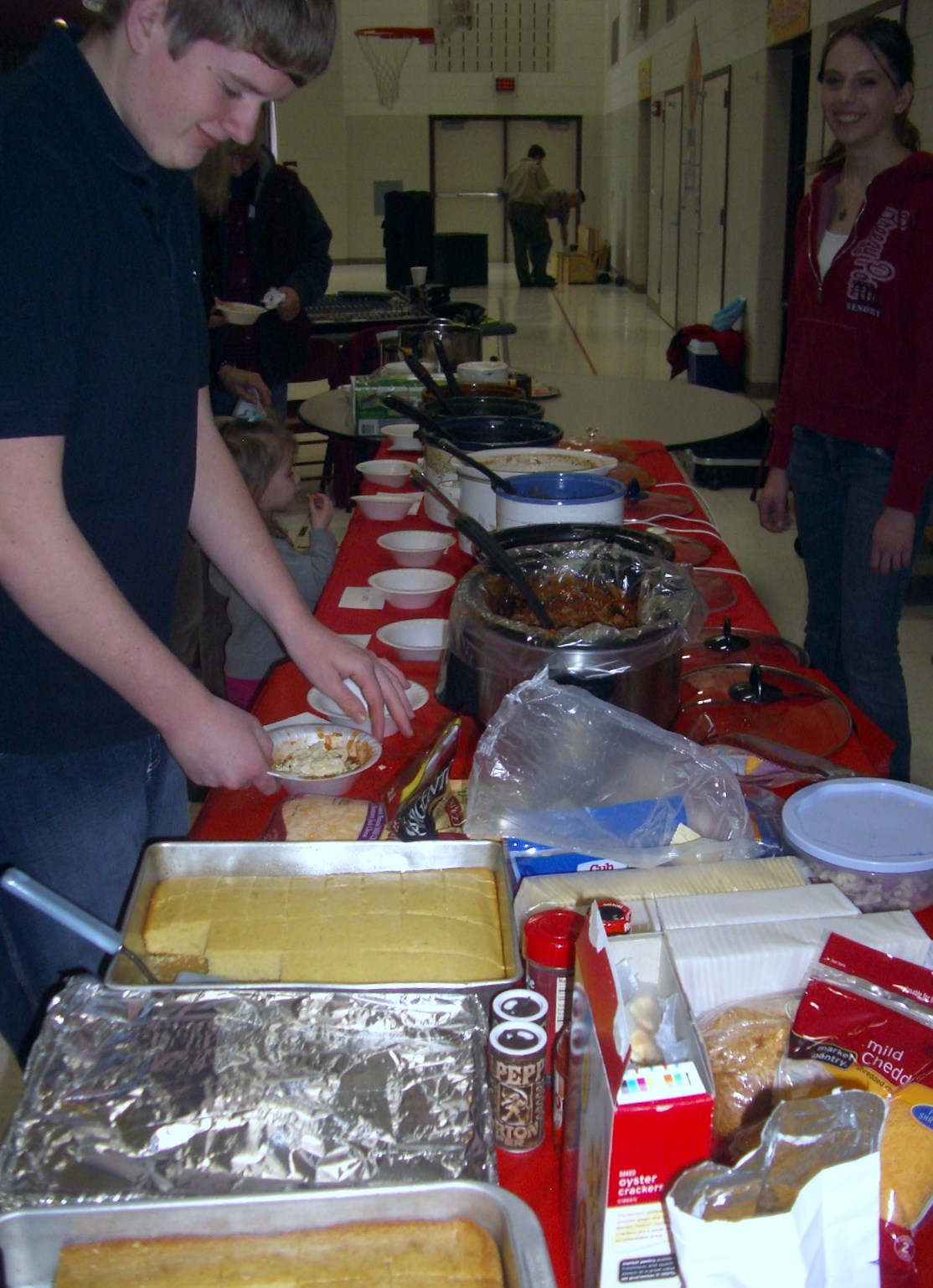

 Last Sunday, as many prepared appetizers and Super Bowl food, our church's youth organized a chili cook-off. Congregation members generously donated crockpots of their favorite recipes and homemade cornbread. Others brought crackers, sour cream, chopped onions, and cheese. Can you imagine the wonderful smell? Hamburger and secret ingredients filled the gym with the spicy aroma of caring for the hungry.
The Souper Bowl of Caring is a youth-led national movement that last year raised over 10 million dollars, which were given to local charities of the group's choice. According to their website, www.souperbowl.org, one in six people (one in four children) in America live in food insecure households. Our youth decided to donate any money gifted to the Farmington Food Shelf.
Two empty soup kettles represented the opposing teams. Suggested donations were $5.00 per bowl, and you voted by placing any amount of money in your favorite team's kettle. People had access to unlimited chili, cornbread and beverages. You were also given a poker chip which you used to vote on your favorite chili.
During the course of the morning, someone started a bowl to donate to the commercials and halftime as the reason to watch. This bowl got $30 in gifts!
Our mission church served over seventy people, and raised $445 dollars to fight hunger in our county. The Packers won the game and raised the most money that morning. It was so much fun; people were relaxed and generous, and are already discussing next year's event. We are considering adding soup as well as chili next year, and making sure the rest of the community knows they are invited!
Saturday, February 5, 2011
Firetrucks and Pillows

I spent a generous amount of time explaining dynamics to a young lad on Thursday. This involved a brief overview of Italian terms forte and piano, their meaning being strong and quiet. I was engaging, took questions, we tried some warm-ups in both. And when I was finished, he replied simply, "that's not what my teacher at school said."
"Well, how did she describe dynamics?" I asked.
"She said that F stands for Firetruck, you know, really loud, like a siren, and that P stands for Pillow, soft."
"I'm glad that your remember that. Can we try them in your piece?"
But I confess. All the while he was playing Firetruck and Pillow I was wondering why in the world would you give different names to the symbols "F" and "P" like this? They're pretty standard, after all. Perhaps in a classroom setting, you're teaching to the lowest common denominator? Perhaps it was a success because he could tell me about it at a different lesson. I have always liked the fact that our instrument was named a Quiet. It didn't much fill much more than a 10x10 room when it began its life so long ago.
There's a phrase on a bumper sticker that says, "Piano is my Forte". Forte. Strong suit, my strength. I can't go around explaining that Piano is my Firetruck, nor do I wish to ever play it with the sound of a siren.
The other item that often tweaks me, while we're at it, is that piano is not soft, but quiet. It is a term of volume, not of touch, in my opinion. I often correct even the method books who use the term "soft" in their piano descriptions. Perhaps I'm in a persnickety mood as I cross out their word and write in "quiet".
Volume on a piano is a matter of the speed in which the key is depressed. The faster that the hammer hits the string the more forte it will be. Yes, then. If you depress the key softly, as in gently, it will be most likely also quiet. It may also be wimpy. I am constantly striving to play my instrument the most well-voiced quiet I can get. I have heard some pianists master their piano, in both senses of the word. So, I want my students to play quietly, and avoid wimpy.
Thanks for listening to my rant today. I feel better. But ranting is not usually my forte. And now I'll be piano.
Sunday, January 30, 2011
Judging the MMTA Contest - 2011

 I had the privilege of being a critical listener to fifty-four 7-8 year olds over a 6 hour span of time on Saturday. The event took place at a local northern metro (Minnesota) college. The Minnesota Music Teachers Association (MMTA) uses the lobby as a registration hub, and many, many rooms in the Fine Arts and Community Center areas for judging over both Saturday and Sunday. Thursday, a local piano store rolled in over a dozen pianos, Friday they were all tuned and tweaked. There is a judge coffee and waiting area, several of the normal campus hangout areas were today occupied by families and piano students.
MMTA does a contest for many different instruments and young artists of every caliber are encouraged to participate. The event this weekend is their piano division preliminary contest. Winners of this event will go to the Final Contest in mid-March. I have judged intermediate and early advanced levels the past few years, so it was very fun to see the young students again. The halls are bustling with students and doorkeepers, all making sure that they make it to the correct room at the correct time, with the correct piece. The preliminary contest this year takes place at many locations around the state, but over 3800 students will participate. It's a big deal.
This was my room; it's really more like a closet or a walk-in refrigerator sized hole. The door shuts if you move the bench back toward the piano, and there is room for one chair. I am left-handed, but the desk chair is rarely a lefty. It's a cozy little area, isn't it? The students and I spend 6 quality minutes together in here.
This is often a child's first experience at a judged event. I try extra hard to be kind and smile broadly. Many of them have spent months learning their 16 measure pieces. They came in their holiday dresses-ruffles, sparkles, bows and ribbons, the young boys in their clip-on ties and button down shirts. Their dress pants were belted, and their hair was combed. Nerves run high. You can feel it in the halls. Parents made a special effort to get here, from far away sometimes. Perhaps they have high expectations for their child musically. Some of them remember participating in an event like this as a child. Most of them are as nervous as the student.
My daughter walked up to this building last spring and still remembered those nervous feelings, years later. She said it felt like she was there to play even though she wasn't, and she didn't like it. Here are a few of the completely cute things that I experienced.
Not knowing that she was supposed to be anonymous, she walked up to the door and said, "HI! My name is Emily!" "Well, hi there, my name is Chris! Would you like to play for me today?"
Another student walked in the room, looked at me and said, "WOW! We're wearing the same colors! I have blue and black on too-see my pretty black flower right here? My shoes are a little tight."
Another said, "Oooh, I really like your earrings. I'm gonna get my ears pierced for my birthday."
About 6 students in a row came in with no front teeth.
After I heard a darling student in a bright orange dress with fushia trim perform, I opened the door to return her music. There were two of them there! "I'm Emma, SHE's Emily. It's her music not mine. Did you know we're twins?"
One student stopped dead in the middle of his piece, turned to me with huge eyes and said, "I'm reaaaalllly nervous!"
"Would you like a do-over? You can have one free start over today. This first one won't count, if you like."
"Really? OK. Free do-overs are great."
And finally, a young lady played her piece really well. It was musical, polished, and confident. She got to the last two measures and there were only two "C"s left. And she completely blanked on C number one. She tried a G, she tried a B, she backed up and started four measures prior, and nailed it. And then she looked like she was going to cry. I quickly raised my finger ala Maria in the Sound of Music. (Remember Maria at the market when the little one dropped the tomato?) "You played well", I smiled, and made eye contact, and smiled some more. All better.
Phew. The students came prepared, and hopefully had a good experience. I can't wait to hear how my own students did.
Subscribe to:
Posts (Atom)
